
(di)atomic garden
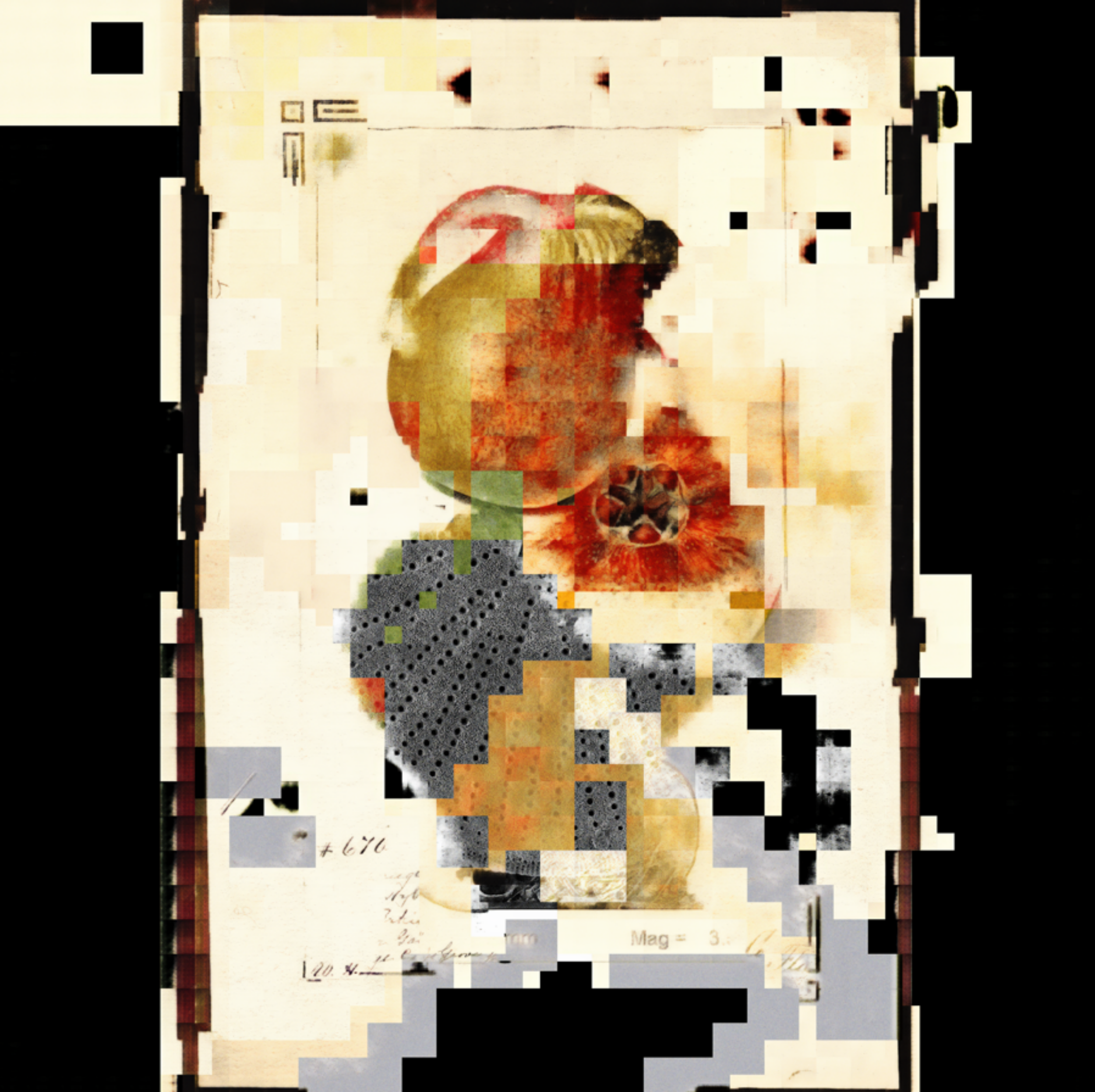
(di)atomic garden
By 2025 Lumen Prize winning Artists Entangled Others
Showing at ORBIT_E, the digital platform of MBAL (Musée des Beaux-Arts Le Locle)
Ends 28 July 2026
In their practice, the artist duo Entangled Others, composed of Feileacan Kirkbride McCormick and Sofia Crespo, questions notions of bias in technology and representation of natural species, proposing a return to a biological model of computation and exploring concepts of entanglement between different species and ecosystems.
For ORBIT_E, Entangled Others created a work that articulates a new contextual framework while drawing on their now well-established methods. (di)atomic garden is a work taking the form of a real-time performative system that explores radioactivity as a force of mutation.
Through a virtual simulation of an atomic garden, two distinct sets of images—historical agricultural crops and Antarctic marine plankton—are related and transformed. Each specimen planted in this virtual space is the result of a meticulous translation of images into pseudo-genetic code and algorithmic encapsulation. The planted specimens can be explored via a web-based interface, which acts as a secure window onto this constantly growing, mutating, and decaying virtual garden.
Radioactivity exerts a powerful transformative effect on genomic material. The work explores how two disparate sets of images (historical agricultural cultures and Antarctic marine plankton), considered as colliding genetic pools, mutate through the virtual simulation of an atomic garden. This garden acts as a bridge between the terrestrial and oceanic realms, whose boundaries are unstable and dissolving.
Charged particle emissions from the decay of uranium ore are sampled and then used to create a virtual reconstruction of the atomic garden, where each image of the planted specimens is translated into simulated genetic code and algorithmic structure. This new virtual form renders them vulnerable to mutations when irradiated by beams of charged particles, causing their transformation and mutual interactions.
The project draws on the little-known history of atomic gardens—experimental fields developed after World War II to study “peaceful” applications of nuclear energy. By exposing crops to radioactive materials, scientists induced mutations that could sometimes lead to higher yields, new colors, or novel shapes.
Remarkably, some of these varieties are still listed in contemporary seed catalogs. Meanwhile, nuclear weapons testing, reactor accidents, and industrial activities have introduced radioactive waste into the world’s oceans. As a result, many marine organisms—from plankton to fish—now live under chronic exposure to low doses of radiation. While the effects of high doses of radiation are well documented, the long-term ecological consequences of low doses remain uncertain, especially when combined with ocean warming and acidification. These unresolved questions form the conceptual backbone of (di)atomic garden .
About the artists
Entangled Others is an experimental artist duo comprised of Feileacan Kirkbride McCormick and Sofia Crespo . In their practice, McCormick and Crespo explore the strange and unsettling spaces that lie between human technologies and non-human worlds, advocating for the dissolution of the distance we ourselves create between ourselves and the richness of our interdependent existence.
Through their work, presented at venues including the Victoria & Albert Museum (London), NeueHouse LA, UNESCO headquarters in Paris, and the University of Oxford, the artists question notions of technological bias and the representation of natural species.
About the curator
Marlene Wenger is an art historian and curator specializing in digital and post-digital artistic practices. Trained at the University of Bern and the Freie Universität Berlin, she received her doctorate in 2021 with a dissertation on post-digital exhibition strategies. After working for Art Basel Unlimited, the Migros Museum, and the Kunstmuseum Bern, as well as curating a private collection of video art, she became program manager and curator at HEK (House of Electronic Arts) in Basel in 2023. There, she co-curated exhibitions including Virtual Beauty (2024) and Other Intelligences (2025), oversaw the Pax Art Awards, and for several years has been developing curatorial projects around digital technology, AI, augmented reality, gaming, and contemporary forms of online subjectivity.
