
World Simulator
Adam Cole, University of the Arts London
Artwork Description:
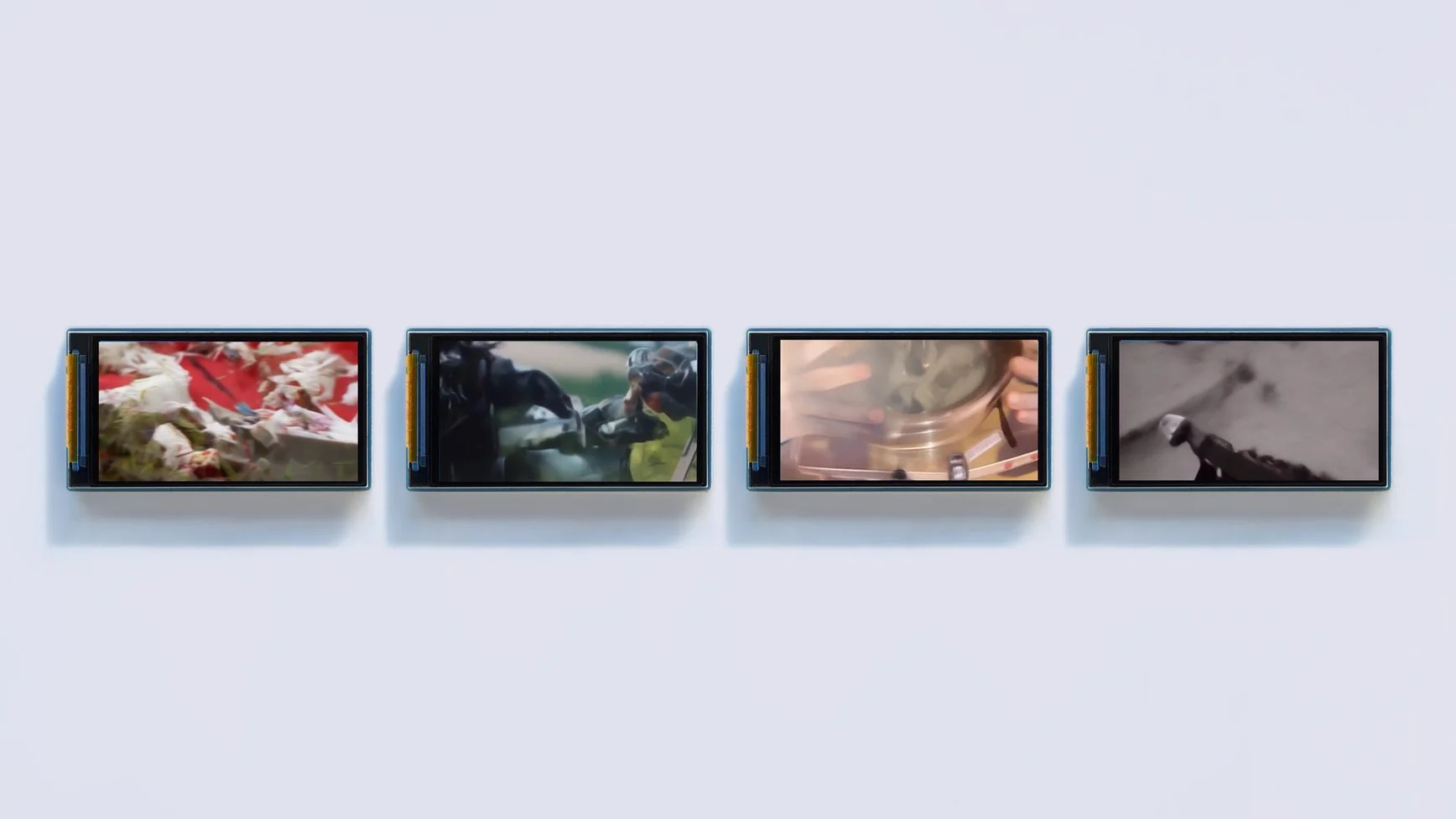
What kind of world simulation can exist without sex? Increasingly, AI video models are marketed as 'world simulators,' suggesting their ability to model infinite realities. Despite such claims, these models systematically exclude significant aspects of embodied human experience, particularly sexuality. World Simulator confronts that claim, exploring the poetic friction between these totalising promises and what the systems can actually represent. The work feeds explicit gay erotica, scenes from Wakefield Poole's 1971 queer underground film Boys in the Sand, into an AI video-to-video pipeline. Lacking the data to recognise this behaviour, the system fails to reproduce the scene. At high denoising steps, the erotic choreography collapses into the mundane: kitchen appliances, strange architectures, abstract flesh. But at low steps, the abstract generation still holds a sensual, suggestive motion. Across four miniature screens, we watch this collapse of possibility into generic AI content. Passing queer erotica through these sterilised pipelines carries a specific charge, given the historical policing and erasure of queer bodies in media archives. The work challenges the hubris of the 'world simulator' label: what does it mean to simulate a human world while remaining structurally blind to sex itself? This is not a call to train models on pornography for 'completeness.' Pornography, too, is a false simulation. We look instead to queer and experimental cinema, which sought not to replicate reality but to transcend it. The machine's failure to make sense of the erotic feels more honest than any perfect rendering: a case for more expansive representations of sensuality.
