Fluid Anatomy
Ioana Vreme Moser
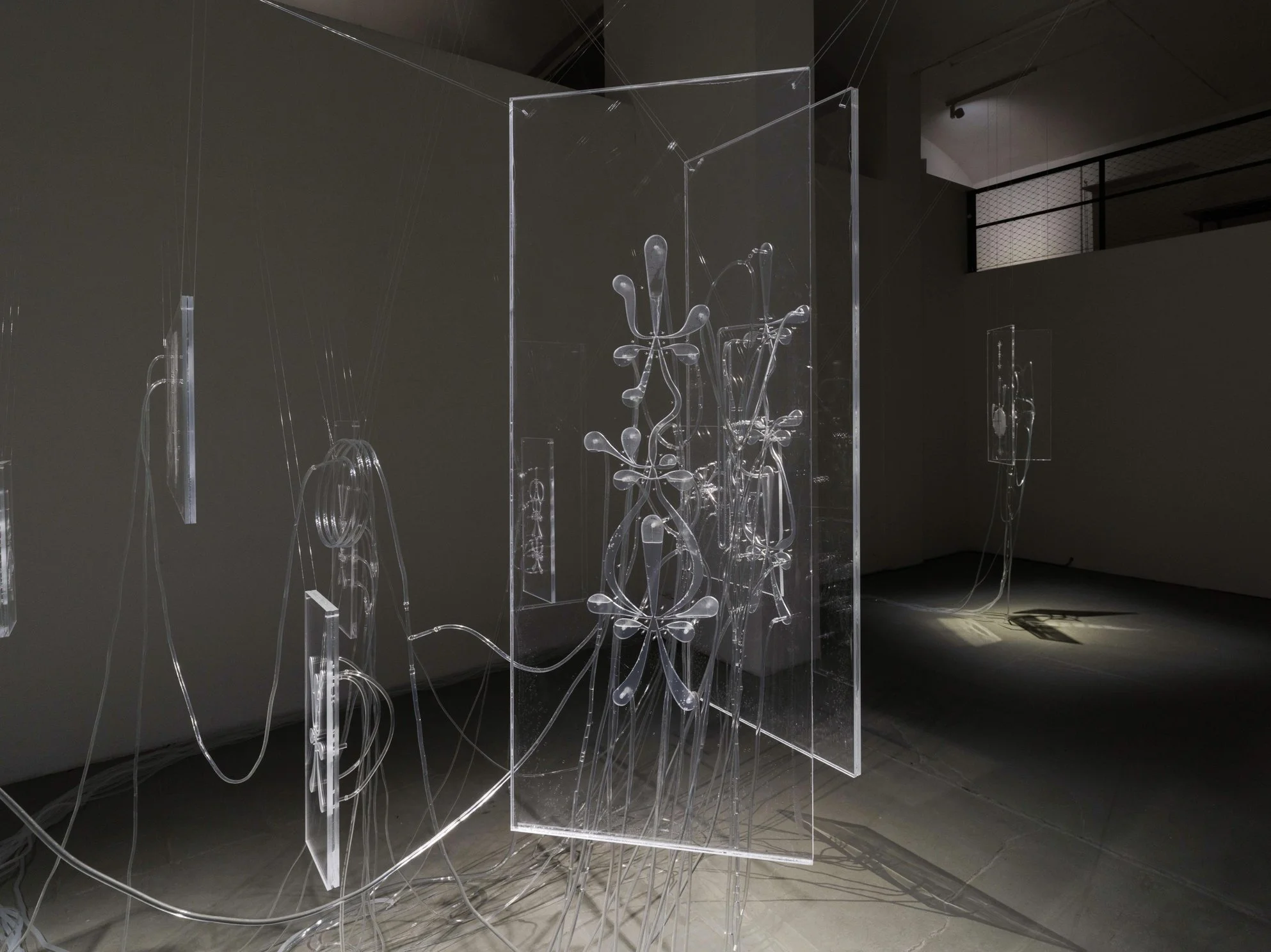
Artwork Description:
Powered by water and air, Fluid Anatomy unveils an analogue hydro-pneumatic computer that guides fluids in a dynamic interplay of movement, pressure, and resonance. The installation exposes over 20 specific fluidic forms restored from old patents and archives, forming a system that prioritises organic movement over speed. Water courses through a branching network of tubes and adheres to convex fluidic morphologies. Form follows function. A large oscillator clocks the system while fluidic sensors trace presence. Circuits comprised of ‘fluidistors’ (fluidic transistors) and logic gates, count, store, compare, subtract, and sum. Parallel air paths drive fluidic oscillators, generating cascaded sound frequencies. Fluidics, or fluid logic, emerged in the 1950s, using fluid jets for operations akin to electronics. Intricate cavities became radiation-resistant switches, powering automation, spacecraft, and heart valves. In 1964, Univac introduced FLODAC, the first fluidic digital computer. Yet, as speed and miniaturisation became paramount, fluidics faded into obscurity. Taking fluidics as a future alternative to electronics, Fluid Anatomy reveals a parallel history in which technology is transparent and resonant while tuned in function to the natural rhythms of fluid flow. Transparent plates and tubes make calculations visible, inviting the public to walk among fluidic bodies, listen to circulating streams, and witness an evolving rhythm of computational motion and sound.
Project Collaborators:
Produced & Curated by singuhr projekte Technical support: Dorian Largen Production support: Jan Rohmer, FabLab.ro Scientific Advice: Dr. Benjamin Bühling. Support received from Musikfonds E.V. (DE); Bezirksamt Pankow, Berlin (DE) Research conducted at: Tangible Music Lab & hosted through Atelierhaus Salzamt, Linz