风喉 Throat of the Wind
Aiwen Ding and Zhi Geng
Artwork Description:
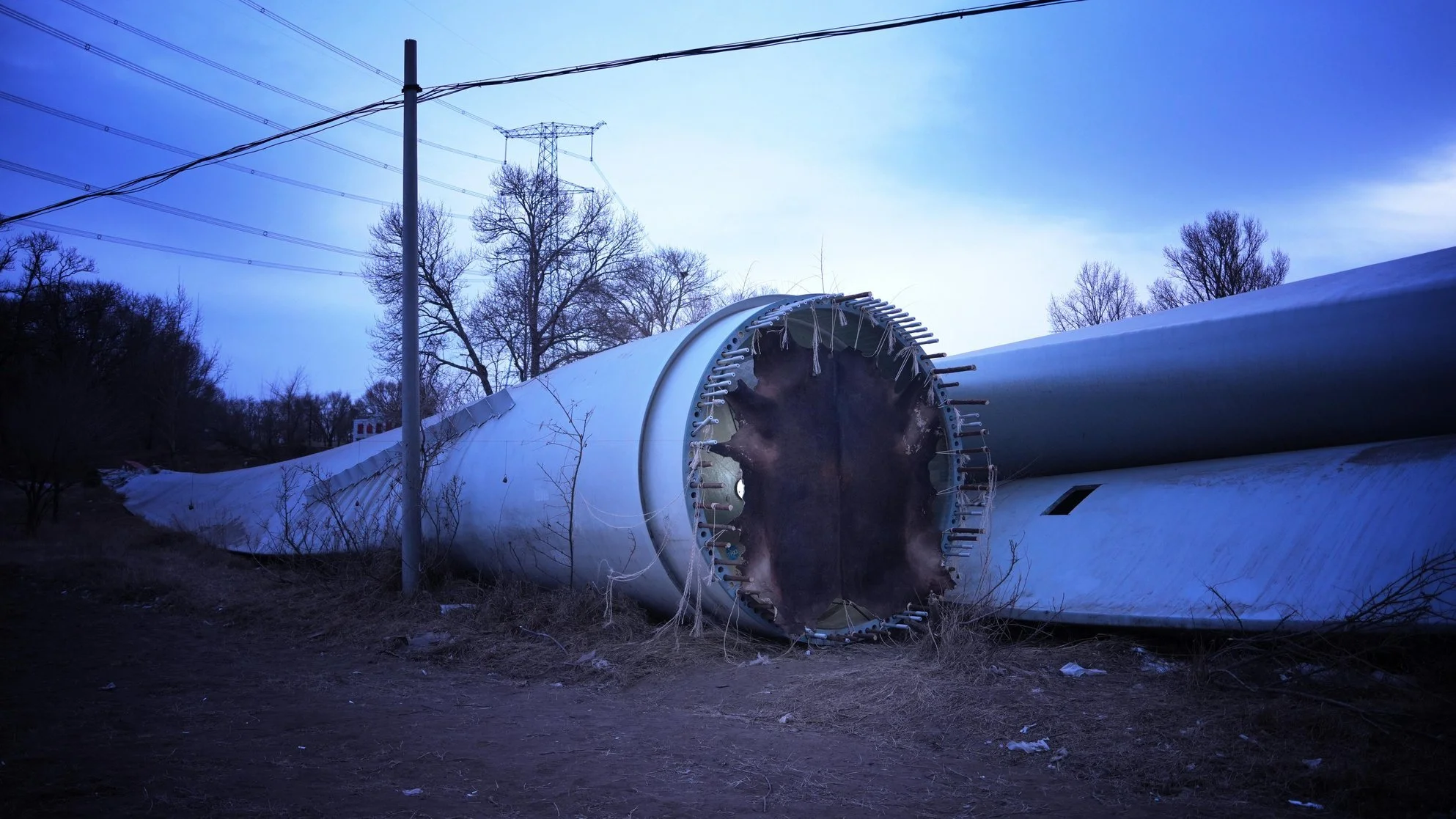
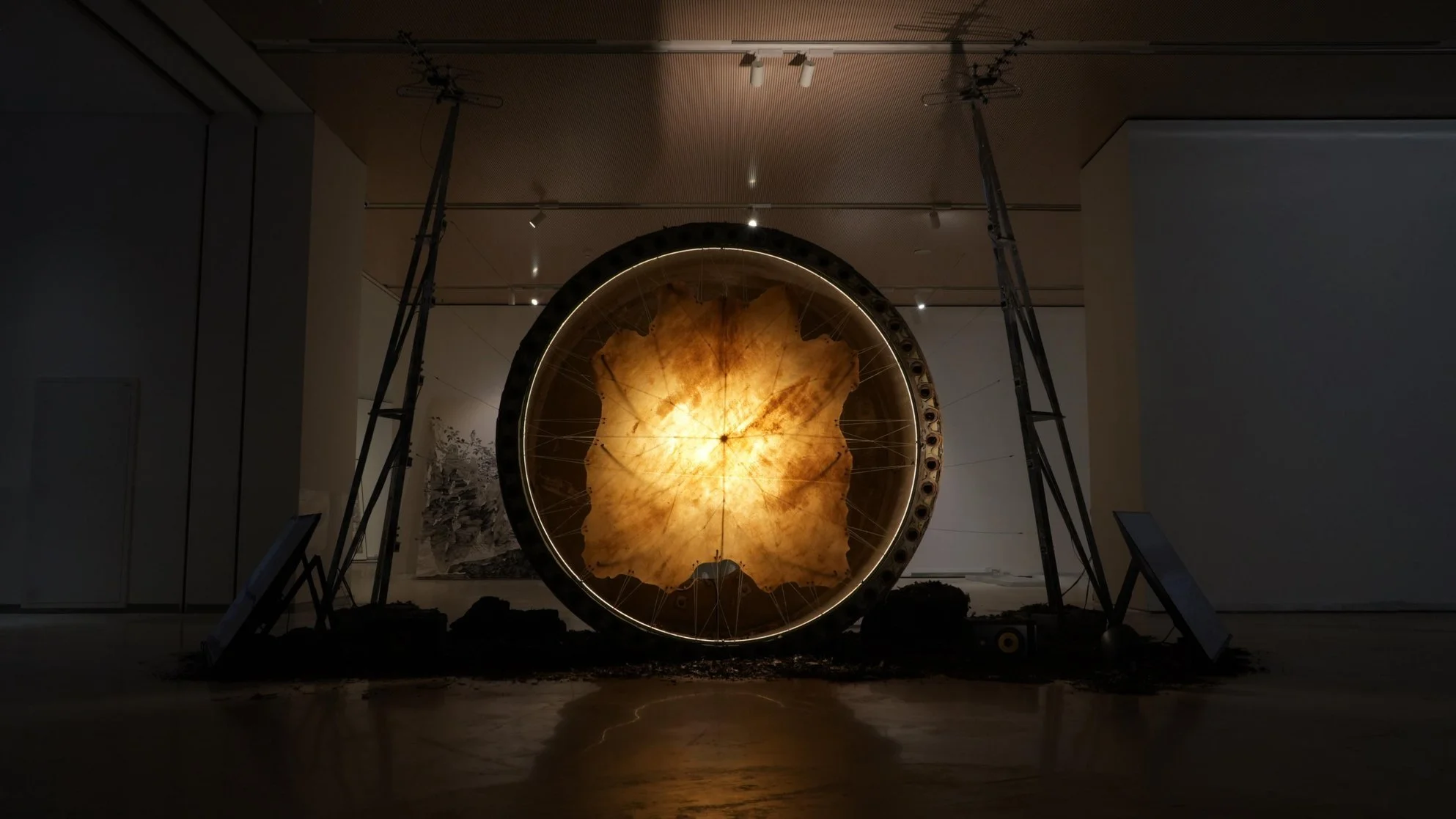
Throat of the Wind is a site-specific sound installation based on long-term field research into China’s energy infrastructure, presented in both site-specifc and gallery versions. The site-specifc iteration centers on a discarded wind turbine blade at Anguli Nao(The largest inland lake on the plateau in North China). Anguli Nao witnessed the drowning of over 3,000 Chinese laborers by Japanese forces during the Second Sino-Japanese War. In 1996, one of China’s early wind power projects was built here; by 2004, the lake had dried up. As wind turbines were gradually decommissioned, their blade remnants were left beside the national highway. For the site-specific work, the artist chiseled through the ice, tanned cowhide with the lake water, and stretched it over the discarded blade to form a resonating chamber. Cables were elevated to connect the blade to a transmission tower 400 meters away, receiving its electromagnetic signals. These signals drive an internal spring to vibrate, while the wind tugs the cables, stimulating the hide to produce sound. The gallery version is built around a blade root from the 1990s. Antennas capture ambient electromagnetic signals, which drive a mechanical system on one side and control a synthesizer on the other, creating a sonic landscape reminiscent of cosmic echoes. From “remains” (the victims, forgotten history, and the abandoned blade), wind, and electromagnetic waves to sound, Throat of the Wind converges natural and historical energies into the blade fragment, transforming it into an instrument of the earth—a “throat” that channels the memory of the land.
Project Collaborators:
On-site Research Partner Guoneng United Power Technology (Baoding) Co., Ltd. Logistics Yaqi Lü, Weiming Chen, Zihan Zhang Equipment Support Beijing Qiyi Shijie Technology Co., Ltd. Beijing Yuanyi Ruibo Technology Co., Ltd. Special Thanks Bin Ding, Fangkui Ding, He Wang, Cheng Yan, Weiqi Zhang, Jiangfeng Zheng